St Hripsime: the church of 618 that set the shape of Armenian churches
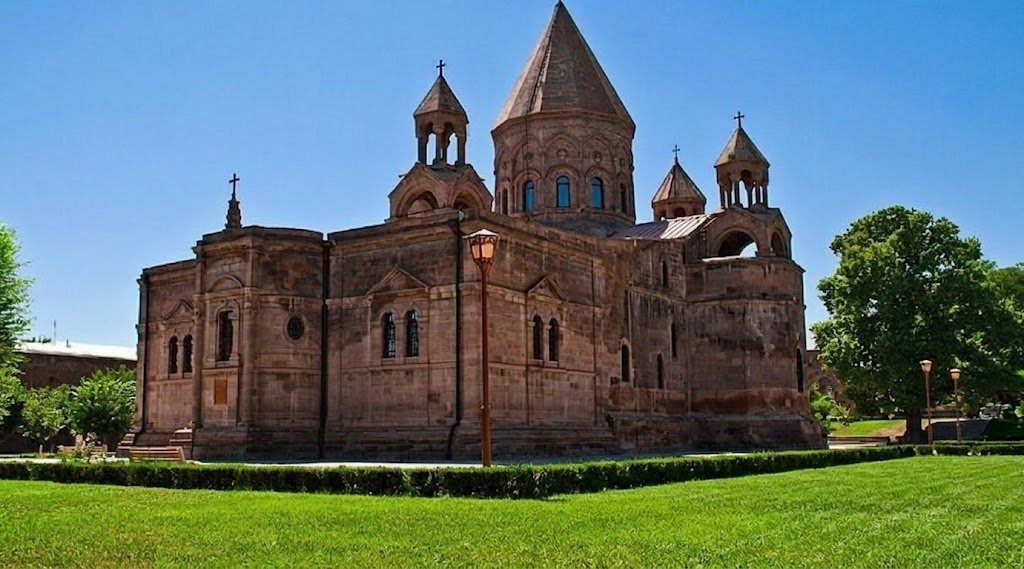
At the entrance to Echmiadzin, coming from Yerevan, to the right of the road, stands a grey stone church with a tall drum and conical dome, alone in a meadow with walnut trees. This is St Hripsime, built in the year 618 and standing almost unchanged ever since: the oldest church in Armenia to keep its original form and the one that set, with its plan of four apses and a dome, the model followed by almost every Armenian church of the following centuries. Since 2000 it has been a World Heritage site together with Echmiadzin cathedral and Zvartnots.
Who Hripsime was
Tradition tells that at the start of the 4th century a group of Roman nuns fled Diocletian, who wanted to marry one of them, Hripsime, and reached Armenia. King Tiridates III saw her, wanted her for himself, she refused him and he had her executed with her companions, among them Gayane, the abbess. The king went mad, Gregory the Illuminator cured him, and the kingdom converted to Christianity. Over Hripsime's tomb a chapel was first raised, in the 4th century, and in 618 Catholicos Komitas built the present church. Her relics are still in the crypt, beneath the altar, and can be visited.
What it is like
From outside it looks like a solid block with triangular niches in the façades and few windows; inside it makes sense: four semicircular apses in a cross, four round niches in the corners and, above it all, an octagonal drum with the dome. It is the type historians call a tetraconch with corner niches, and St Hripsime is its purest example. There are no frescoes and hardly any decoration: the stone, the light coming down from the dome and the proportions are the building. The bell tower at the entrance dates from 1653 and the towered wall around it from the 18th century.
Feast and worship
It is a working church, with services and many weddings, because Armenians like to marry here. The feast of St Hripsime and her companions is celebrated in June, on a date that changes each year with Pentecost, with a solemn liturgy and pilgrims from all over the country. Echmiadzin has two other churches from the same story: St Gayane, from 630, over the abbess's tomb, and Shoghakat, from 1694.
Visit
It is seen with Echmiadzin cathedral and St Gayane, all ten minutes on foot or five by car, and with Zvartnots on the way. From Yerevan, twenty to thirty minutes by car or marshrutka. Free entry; discreet clothing is expected, shoulders and knees covered, and silence during services.
Frequently asked questions
Why is it important?
It is the church of 618 built over the tomb of Hripsime, the martyr whose death, according to tradition, set off the conversion of Armenia, and the first example of the central domed plan that defines Armenian architecture. A World Heritage site since 2000.
Who was St Hripsime?
A Roman nun who, according to tradition, fled Diocletian, reached Armenia and was executed by King Tiridates III for refusing him, at the start of the 4th century. Her death precedes the king's conversion by Gregory the Illuminator.
Can it be visited?
Yes, it is free and open every day. It stands at the entrance to Echmiadzin and is seen with the cathedral and St Gayane. Shoulders and knees covered.


