Martuni, on the southern shore of Lake Sevan: the pass-through town worth a stop, the Vanevan monastery, the southern beaches and the fish of the lake
If you come down the Selim pass towards Lake Sevan, the first town you reach, where the mountain road meets the one circling the lake, is Martuni: some 12,000 people, at 1,950 metres, with the water two kilometres away and the lake wind in the streets. It is not pretty and does not pretend to be, with its apartment blocks and its market, but it is the base for the southern shore, the one the tourist coaches do not touch, and from here the Vanevan monastery of the year 903, the empty beaches of Tsovinar and Artsvanist, the khachkars of Noratus and lake fish at a table by the water are all within reach. This guide tells what there is in Martuni and around it, and how to use it on a journey through central Armenia.

What Martuni is
The village was called Nerkin Karanlugh, and in 1926 Soviet Armenia gave it the party name of Alexander Myasnikyan, the Armenian Bolshevik leader who had died the year before in a plane crash; the Martuni of Karabakh, today Khojavend under Azerbaijan, was named after the same man, and it is best not to confuse them. It grew as the farming and fishing centre of the southern shore, with the lake as its larder, and is today the de facto capital of that part of Gegharkunik: market, hospital, marshrutka station and an avenue with cafés where those coming from Vayots Dzor over the pass cross paths with those going from Sevan to Vardenis. The climate rules: long snowy winters, short cool summers and no vines, which do not ripen here; what is grown is potatoes, wheat and cabbage, and what is eaten is fish.
The lake from the south
The northern shore of Sevan, the one with Sevanavank and the hotels, is 70 km away, and the southern one is something else: sand and pebble beaches with no buildings, between Martuni, Tsovinar and Artsvanist, with cold clean water and, in July and August, local families and almost nobody else. Those who can stand the cold swim, and at the roadside restaurants you eat the lake fish, the sig, the whitefish introduced in the 1920s which is what is caught, and boiled crayfish in season, while the ishkhan, the Sevan trout, is ever rarer and protected. At sunset the lake turns a colour you do not see in the north, because here you look towards the Gegham mountains with the sun behind them.
Vanevan and Noratus
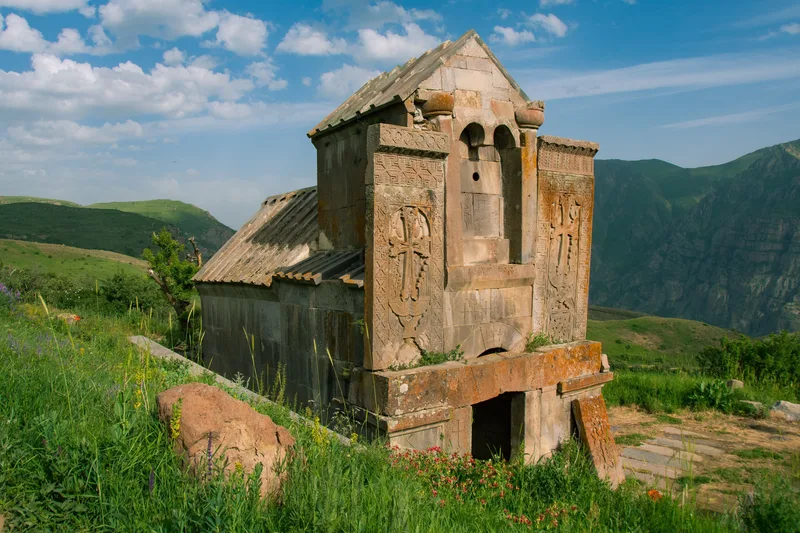
Eight kilometres east, in the village of Artsvanist, is the Vanevan monastery, founded in 903 by Prince Shapuh Bagratuni and his sister Mariam, the same one who built Sevanavank; it is a small group in dark tuff, the church of Saint Gregory with its gavit and a chapel, on a hillside with a village around it, with no entry fee and no visitors, seen in half an hour and worth the detour. And twenty kilometres north-west, on the way to Gavar, Noratus, the cemetery with some eight hundred khachkars, the largest that remains, where you stop for half an afternoon to look at the stone crosses from the 10th to the 17th century and listen to the village women who sell socks and tell the legend of Tamerlane.

How to get there and how to fit it in
Martuni is 130 km from Yerevan by the Sevan motorway and the shore road, two hours, with marshrutkas leaving Yerevan several times a day; from Yeghegnadzor, in Vayots Dzor, it is 70 km over the Selim pass, with the Orbelian caravanserai halfway, open from May to October. The sensible thing is to arrive over the pass, stop at the caravanserai, come down to Martuni to eat fish, see Vanevan and carry on along the shore to Noratus and Sevanavank before returning to Yerevan, all in one long day; anyone wanting a quiet night by the lake finds family guesthouses and a couple of simple hotels in Martuni and Tsovinar, with sunrise over the water in return.
Frequently asked questions
What is special about Martuni?
Little in the town and a fair amount around it: it is the base for the southern shore of Sevan, the one without hotels or coaches, with the empty beaches of Tsovinar and Artsvanist, the Vanevan monastery of 903 eight kilometres away, Noratus twenty away and lake fish on the table. It is a stop on the way between Vayots Dzor and Sevan more than a destination.
Is there anywhere to stay?
There are family guesthouses in Martuni and in the shore villages, Tsovinar and Artsvanist, and a couple of simple hotels in town, enough for a night; in July and August it is wise to book, and the rest of the year to ask whether they are open. For hotels with more services you have to go to the northern shore, to Sevan.
Which region is Martuni in?
In Gegharkunik, the province of Lake Sevan, on the southern shore, at 1,950 metres. There is another Martuni, in Karabakh, today called Khojavend and under Azerbaijan, and several small villages with the same name; the one in the guidebooks and on this page is the one by the lake.