Lahij: the coppersmiths' village, with its stone streets, its thousand-year-old sewers and a Persian language at the top of the gorge
You arrive through a gorge of the Girdimanchay river, 20 km of narrow road between walls, and at the end, at 1,200 m, a village of grey stone appears with a long cobbled street and, before you see it, you hear it: the hammering of the copper workshops that have been at work for two centuries in Lahij, Azerbaijan's coppersmiths' village, on the slopes of the Greater Caucasus 170 km from Baku. Here Tat, an Iranian language, is spoken, the houses are built with timber beams set in the stone to withstand earthquakes and beneath the streets runs a drainage system more than a thousand years old. This guide tells the craft, the village, the walks, how to get there and how to carry on.

The copper
In the 18th and 19th centuries Lahij was the copper centre of the Caucasus: hundreds of workshops cast, beat and engraved jugs, trays, samovars, pans and helmets sold from Tabriz to Dagestan, and knife-making and wrought-iron padlocks completed the trade. Today some twenty workshops remain on the main street, with the forge at the back, the anvil at the door and the master chiselling the geometric and floral patterns that are the village's mark. You go in, watch how it is done and buy on the spot at workshop prices: an engraved tray, a water jug, a ladle, a knife with a horn handle. It is the Caucasus souvenir you actually use afterwards.
The village
A main street half a kilometre long, paved with river cobbles, with the workshops and houses on either side, and lanes climbing the hillside. The houses are of grey stone with rows of timber beams set into the wall every metre, which is what has kept them standing in an earthquake zone, with carved wooden balconies and ironwork from the village's own workshops. Beneath the street runs the kürəbənd, a sewer of stone channels built more than a thousand years ago and still working, with spring-water fountains along the way. There are two mosques, the Zavaro of 1791 and the Agholu of 1914, which today houses the local history museum with copper pieces by the best masters, and the remains of the baths. Lahij is on the World Heritage tentative list and, in summer, on the list of everyone from Baku, so weekdays are better.

The walks
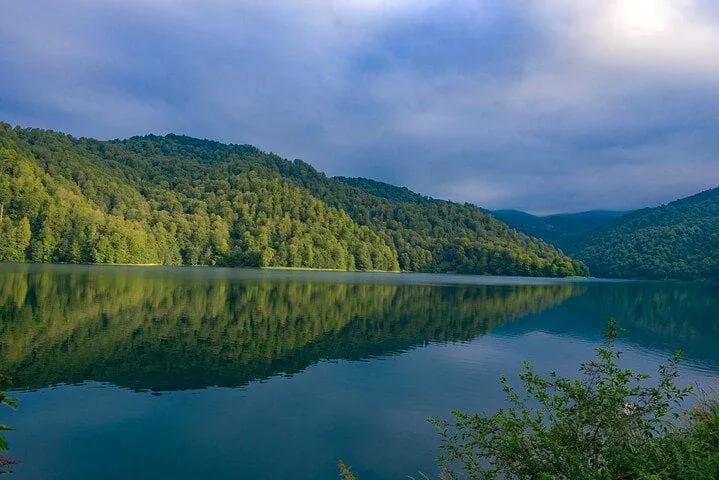
From the village trails lead through the Girdimanchay valley and the beech and oak forests of the slopes, with small waterfalls, pastures and views of Babadag, 3,629 m, the sacred mountain of the area; there are one-hour walks to the neighbouring villages and day routes to the upper meadows, with a village guide or the map on your phone. May to October; in winter it snows and the gorge closes at times.
How to get there and how to carry on
From Baku, two and a half hours of motorway to Ismayilli and from there 40 km, the last 20 through the gorge, on a road largely paved, with narrow stretches and no barrier, done in an ordinary car with care; by public transport, a marshrutka from Baku to Ismayilli and a taxi to the village. There are family guesthouses with dinner and breakfast, which is the way to see the village once the day buses leave. Lahij combines in two days with Sheki, two hours further north-west, with the Albanian church of Kish and the khan's palace, which is the north-western route of Azerbaijan.
Frequently asked questions
How do you get there from Baku?
By motorway to Ismayilli, two and a half hours, then 40 km of mountain road, the last 20 through the Girdimanchay gorge, largely paved and narrow, done slowly in an ordinary car; no 4x4 is needed except in snow. By marshrutka to Ismayilli and taxi to the village, or on a day trip from Baku.
What do you buy?
Engraved copper: trays, water jugs, ladles, small samovars, bowls and plates with the village patterns; knives with horn handles and wrought-iron padlocks; and woollen socks and jams from the houses. You buy at the workshop, where you watch it made, at reasonable prices; bring cash.
Is there anywhere to stay?
Yes, half a dozen family guesthouses with a room, dinner and breakfast, which are the best way to know the village once the day visitors leave; it can also be done as a trip from Ismayilli or from Baku. On summer weekends it is wise to book.