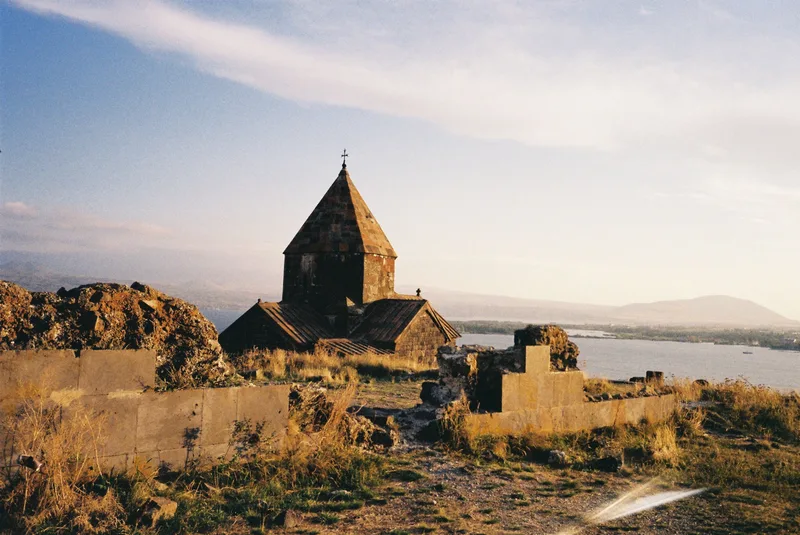
Hovhannavank: the monastery of the Kasagh canyon with the parable carved over the door
The Kasagh river comes down from Aragats towards Ashtarak through a straight, deep canyon, and on its edge, in the village of Ohanavan, stands a monastery of reddish stone with a dome on a drum and a wall. This is Hovhannavank, the monastery of St John the Baptist, 30 km from Yerevan. Five kilometres upstream, on the same edge, is Saghmosavank, built by the same family in the same years, and the two can be seen in a morning with the mass of Aragats opposite.
The old and the new
Tradition says Gregory the Illuminator founded a church here in the 4th century, when Armenia had just become Christian, and from that period or the next dates the single-nave basilica attached to the north side, small and dark, rebuilt in 1652 but with the old walls. The big church, Surb Karapet, was built between 1216 and 1221 by Prince Vache Vachutian, the lord of the area under the Zakarians, and his son Kurd added the gavit in 1250. It is the same pattern as Saghmosavank: the family built in pairs.

What to look at
The church door, inside the gavit: the tympanum carries a relief of the parable of the wise and foolish virgins, with Christ in the centre and the ten figures on either side, five with their lamps lit and five looking as if they arrived late. It is one of the few narrative reliefs in medieval Armenian sculpture and is worth the visit on its own. The gavit has four columns and a dome with a lantern, and the church a sixteen-sided drum that collapsed in the 1918 earthquake and was rebuilt. Outside, khachkars, the cemetery and the precipice.
The canyon
From the wall you see the Kasagh a hundred metres below, and along the edge runs a path linking Hovhannavank with Saghmosavank in an hour and a half of level walking, one of the pleasantest short walks near Yerevan. A path goes down to the river, and there are caves in the cliff that were hermits' cells.
With Saghmosavank and Amberd
The usual plan is a day from Yerevan: Hovhannavank, Saghmosavank, the monument to the Armenian alphabet by the road and the climb to the fortress of Amberd, on the slope of Aragats at 2,300 metres, open from May to October. Free entry to both monasteries; they are working churches, with weddings at weekends.
Frequently asked questions
When was it founded?
Tradition traces the first church to the 4th century and Gregory the Illuminator; the surviving basilica is from the 4th-5th centuries, rebuilt in 1652. The main church is from 1221 and the gavit from 1250.
How do you get there from Yerevan?
It is about 30 km via Ashtarak, half an hour by car, to the village of Ohanavan. It combines with Saghmosavank, five kilometres away, and with Amberd in the same morning.
What sets it apart from other monasteries?
The mix of a basilica from the first Christian centuries with the 13th-century church and gavit, the relief of the wise and foolish virgins over the door and the setting on the edge of the Kasagh canyon, with Aragats opposite.