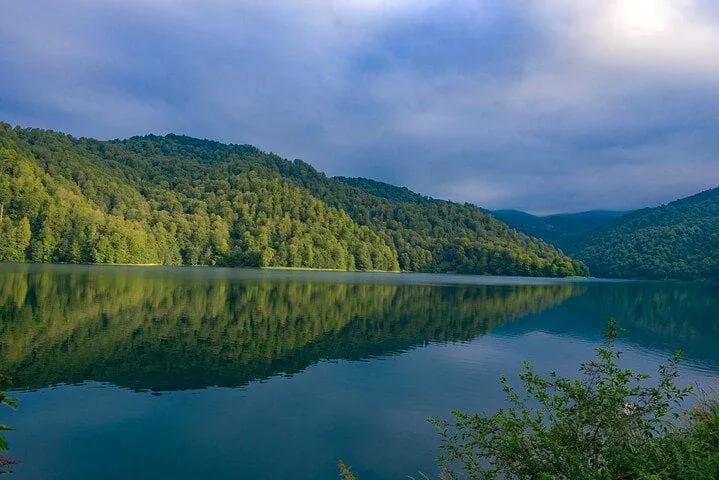
Mingachevir: the city of the Kura reservoir, Azerbaijan's sea, with its summer beaches, its Olympic rowing and an Albanian temple under the water
In the middle of the dry plain between Baku and Ganja there is a sea: 605 km² of blue water that the Kura river backs up behind an 80 m earth dam, and on its shore a city of wide streets and 1950s buildings that did not exist before the dam. This is Mingachevir, Azerbaijan's sea, as the people of Baku who come to swim in July call it, and it is a stop almost nobody makes on the way to Ganja and Sheki and which deserves an afternoon: for the water, for the promenade, for the rowing and for what was there before the water, a city of Caucasian Albania that archaeologists dug out in a hurry before the reservoir covered it. This guide tells what there is and how to fit it in.
The dam and the city
The dam was begun in 1945, as soon as the war ended, and the city was raised at the same time for the workers, German prisoners of war among them, who left the first architecture and a cemetery; the dam was closed in 1953, the hydroelectric plant was switched on in 1954 and for decades it was the largest in the Caucasus, lighting half of Azerbaijan and irrigating the whole Kura plain. The city grew with the electricity: a thermal power station, textile and cable factories, and a population now around a hundred thousand. What it has of the planned Soviet city, straight avenues, blocks, a big park and the shoreline promenade, is what makes it different from the country's old towns.

The water
The reservoir is what you come to see and use. In July and August the beaches of the southern shore fill with families from Baku and Ganja, with cabins, parasols, boats for hire and restaurants serving lake fish, which in Mingachevir is mostly grilled carp and pikeperch; the water is fresh and warm and you swim without any trouble. The shoreline promenade, with its plane trees and benches, is the place for sunset. And in the canal beside the city Azerbaijani rowing trains: the Kur Olympic centre, with regatta lanes, hosts European championships and you can watch the rowers first thing in the morning. In spring and autumn, fishing and birds on the northern shore, where the reservoir opens into arms between hills.
What was there before the water
Before the valley was flooded, between 1946 and 1953, archaeologists hurriedly excavated on the right bank of the Kura a city of Caucasian Albania, the Christian kingdom that preceded Azerbaijan, and brought out a temple from the 5th to 7th centuries with inscriptions in the Albanian alphabet, among the very few that exist, pottery, glass and tombs from the Bronze Age to the Middle Ages. The best of it is in the History Museum in Baku and in the local museum in Mingachevir, which is small and surprising. Of the site, under the water and under the city, nothing remains to see, but it explains why this place was already three thousand years old when the city was founded.
How to get there and what to combine it with
Mingachevir is 280 km west of Baku, three and a half hours along the Ganja motorway and a 20 km turn-off north; there are buses and marshrutkas from Baku bus station and from Ganja, 60 km away, an hour. The logical thing is to stop for an afternoon and a night on the way to Ganja and Goygol, or between Ganja and Sheki, which is 90 km away by the northern road. There are hotels and restaurants on the shore and in the centre; May to September for the water, and the rest of the year for the museum and the promenade.
Frequently asked questions
What can you do at the reservoir?
Swim at the shore beaches in July and August, hire a boat or a pedalo, eat lake fish at the shoreline restaurants, stroll at sunset and watch the rowers train in the Olympic canal; in spring and autumn, fish and watch birds in the northern arms. There are no organised beaches outside summer.
Is it worth it for a tourist?
As an afternoon-and-night stop between Baku and the west, yes: it is a new Soviet city beside an inland sea, with good fish, a museum with Caucasian Albanian pieces and no tourism, which for anyone who has already seen Baku and Sheki is a change. As a destination in itself, only for those after the reservoir in summer.
Can it be combined with other cities?
Yes, it lies between Baku and Ganja, 60 km from Ganja and 25 more from Lake Goygol, and 90 km from Sheki by the northern road, so it fits into any route through the west of the country as an intermediate night. With a car you do Baku, Mingachevir, Sheki and Ganja in three or four days.