Bavra: the northern crossing between Armenia and Georgia, how to cross, what is on each side and why it suits you if you are going from Gyumri to Vardzia
Between Armenia and Georgia there are three land crossings, and the one almost everyone uses is Bagratashen and Sadakhlo, on the Yerevan to Tbilisi road. The second is Bavra, a village on the Ashotsk plateau at 2,000 metres, some 60 km north of Gyumri, through which you enter Javakheti, the region of Armenian villages in southern Georgia, with Ninotsminda five kilometres away and Akhalkalaki thirty. There is nothing to it, and no reason to pretend otherwise: it is a border post on a high, cold steppe, with lorries and marshrutkas and little else. It suits anyone coming from Gyumri who wants to carry on to Vardzia, Akhaltsikhe and Borjomi without going round through Tbilisi, and this guide tells how to cross, what is on each side and when to choose it.

The three crossings between Armenia and Georgia
Bagratashen-Sadakhlo, in Tavush, is the main road one, used by the buses and shared taxis from Yerevan to Tbilisi, open 24 hours and with queues in summer. Bavra-Ninotsminda, in Shirak, is the north-western one, Gyumri's, through which you enter Javakheti and carry on to Akhalkalaki, Vardzia, Akhaltsikhe and Borjomi, or to Tbilisi via Tsalka. And Gogavan-Guguti, in Lori near Tashir, is the third, with little traffic, coming out at Dmanisi on the Georgian side. All three are open to foreigners; the difference is public transport, which at Bavra and Gogavan is scarce.
How to cross
With a valid passport and nothing else, if you hold a European Union passport: Armenia lets you in without a visa for up to 180 days and Georgia for up to a year, and on both sides they stamp and ask little. The Armenian and Georgian posts are a few hundred metres apart, which can be walked, and you cross on foot, in your own car or in whatever vehicle brings you; with a hire car you need the company's permit to take it out of the country and Georgian insurance bought at the border, which is sold right there. The crossing works 24 hours, but in winter the Ashotsk road closes in blizzards and it is better to cross by day. There is no cash machine or reliable exchange, so carry some lari or dollars, and on the Georgian side there are SIM cards and little else.
The landscape at the border
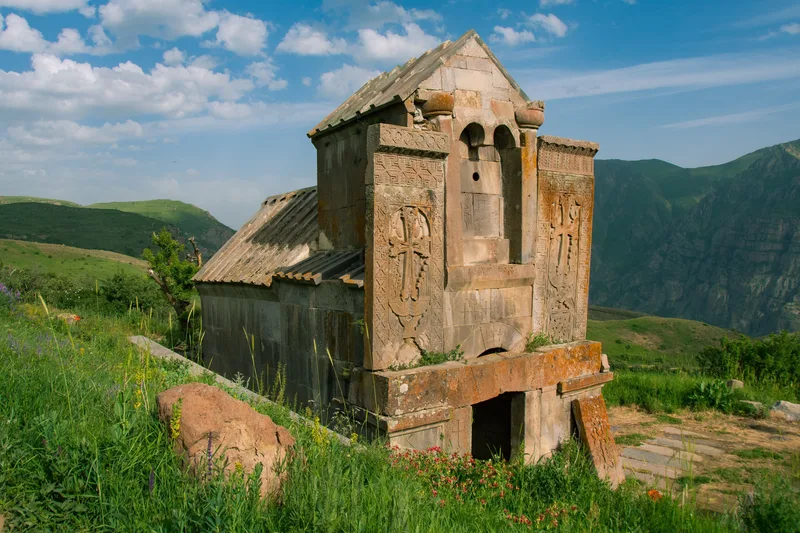
The road from Gyumri climbs through Ashotsk, the coldest part of Armenia, a treeless plateau at 2,000 metres where winter drops below minus thirty and summer is grass, cows and fast clouds. To the left of the road lies Lake Arpi, a national park since 2009 with pelicans and thousands of passing birds in spring, and villages of low stone houses with tin roofs; across the line, Javakheti carries on the same, with lakes Madatapa and Paravani, the highest in Georgia, and villages where Armenian is spoken. It is a highland landscape nobody expects between two wine countries, and worth the hour on the road.

Transport and where to go next
From Gyumri there are marshrutkas to Akhalkalaki which cross at Bavra, with irregular times you have to ask about at the bus station, and taxis to the border in an hour; from Yerevan, the sensible thing is to reach Gyumri first, two hours by marshrutka or two and a half by train, and see the Black Fortress and take a walk through the city before carrying on. On the Georgian side there are taxis at the border to Ninotsminda and Akhalkalaki, and from Akhalkalaki marshrutkas to Akhaltsikhe and Tbilisi; Vardzia is about 70 km from the crossing, Borjomi 110 and Tbilisi 170 by the Tsalka road, which is paved. Anyone who only wants to go from Yerevan to Tbilisi does better to cross at Sadakhlo.
Frequently asked questions
What documents do you need to cross at Bavra?
A valid passport, with enough validity for the stay, and nothing else if it is from the European Union, the United Kingdom, Switzerland or most of the Americas: Armenia lets you in without a visa for up to 180 days and Georgia for up to a year. With a car, the vehicle papers, the rental company's permit to leave the country and Georgian insurance, bought at the border.
Is it open all year?
Yes, the crossing works every day and 24 hours, but the Ashotsk plateau has one of the harshest winters in the Caucasus, with temperatures of minus thirty and blizzards that close the road for a few hours; from November to March it is best to cross by day, with winter tyres and after checking the forecast before leaving Gyumri.
Is there public transport between Gyumri and Georgia via Bavra?
There are marshrutkas from Gyumri to Akhalkalaki that cross at Bavra, a few a day and without fixed times, which you ask about at Gyumri bus station the day before; the alternative is a taxi to the border, crossing on foot and taking another taxi on the Georgian side to Ninotsminda or Akhalkalaki, from where marshrutkas leave for Akhaltsikhe and Tbilisi.